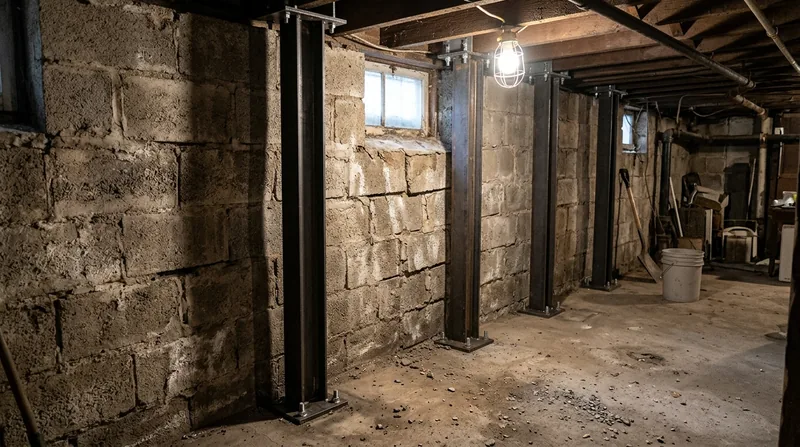




Bowing Wall Repair in Frederick
Frederick sits in the Monocacy valley at the foot of the Catoctin Mountains, where red clay soil over limestone and shale holds water hard in spring and pushes against foundation walls all year. The 1800s brick rowhouses and foursquares near Carroll Creek and downtown often have stone or early block foundations that were never designed for modern hydrostatic pressure, and a hard freeze can open a bowing wall overnight. Bowing Wall Repair in Frederick means reading the wall, the soil, and the water behind it before we touch a single strap. We stabilize leaning and bulging walls with carbon fiber straps, steel I-beams, or wall anchors matched to the severity of the movement. If you have noticed a wall pulling away from the floor joists or a horizontal crack widening at mid-height, start with a free basement inspection so we can measure the movement and tell you what is actually happening.
Why Bowing Walls Show Up So Often in Frederick's Older Blocks
Most bowing walls we open up in Frederick are block or stone walls built before 1940, and the pattern is almost always the same: clay soil stays wet against the outside face, freeze-thaw cycles push the wall inward, and the mortar joints at mid-height give first. The wall does not fail all at once. It leans a little more each spring, and the horizontal crack at the middle course tells you the pressure is coming from outside, not from the floor.
- Hydrostatic pressure from saturated red clay pushes against the wall face after every heavy storm.
- Freeze-thaw cycles open old mortar joints and let water sit inside the wall cavity.
- Failed footing drains from the 1920s and 1930s leave groundwater with nowhere to go but against the foundation.
- Downspout discharge dumped at the corner of the house soaks the same clay that is already pushing inward.
- Efflorescence and white salt staining on the interior face confirm water is moving through the block.
A wall that leans less than an inch over eight feet is often stable enough to monitor, but a wall with visible bulge at mid-height needs strapping before the next wet season.
Key info: On a 1920s foursquare off West Patrick Street, we found a block wall bowed 1.5 inches at mid-height with a horizontal crack running four courses. The footing drain was clay tile collapsed under the sidewalk. Carbon fiber straps stabilized the wall and a drain tile repair relieved the pressure behind it.
Maryland requires home improvement contractors to be licensed through the Maryland Home Improvement Commission, and you can verify any contractor's registration at the MHIC license lookup before work begins.
How We Diagnose and Stabilize a Bowing Wall in Frederick
We do not quote a bowing wall repair from a photo. The first visit is a measurement visit: we check plumb with a level at three heights, map the crack pattern, and look at the soil and drainage on the outside face. On a walkout lot in Urbana or a graded subdivision off Opossumtown Pike, the pressure often comes from a single low corner where the grade falls toward the house.
- We measure the wall's deflection at the top, middle, and bottom to establish a baseline in inches.
- We inspect the footing drain, window wells, and grade on the exterior to find where the water is entering the clay.
- We check the floor joists and sill plate for separation, which tells us whether the top of the wall has moved.
- We recommend the repair method that matches the deflection, not the one that is easiest to sell.
- We install carbon fiber straps, steel I-beams, or wall anchors and record the post-repair measurement.
- We correct the water source with exterior basement waterproofing or interior drainage so the wall is not pushed again.
Stabilizing a wall without addressing the water behind it is a temporary fix, and we tell homeowners that plainly on the first visit.
Key info: A 1950s block basement in Brunswick had a wall leaning 2 inches at the top after a February freeze. We installed steel I-beams on 4-foot centers and tied them to the floor joists, then extended the downspouts 6 feet away from the foundation. The wall has not moved since.
Repair Methods We Use and When Each One Fits
There is no single right answer for a bowing wall. The method depends on how far the wall has moved, whether the top or the middle is deflecting, and how much clay pressure is behind it. We match the repair to the measurement, not to a package price.
| Approach | Description | Best for |
|---|---|---|
| Carbon fiber straps | Straps bonded to the interior face and anchored to the floor and sill to resist inward movement. | Block walls with less than 2 inches of deflection and no active water entry. |
| Steel I-beams | Vertical beams set against the wall, anchored to the footing and tied to the floor structure. | Walls bowed 2 to 4 inches where the top has moved and the sill is separating. |
| Wall anchors | Plates on the exterior clay side connected through the wall to interior brackets. | Walls that need to be pulled back toward plumb, not just held in place. |
| Epoxy injection | Structural epoxy ports drilled into the crack and filled under pressure. | Non-moving vertical cracks in poured walls that need to be sealed and bonded. |
| Polyurethane injection | Flexible foam injected into cracks that are still moving or seeping water. | Active leaks and cracks that open and close with the seasons. |
If the wall has moved more than 4 inches or the block is crushing at the heel, we refer the job to a structural engineer before we touch it, and we say so on the estimate.
Bowing Wall Repair Cost in Frederick: What to Expect
Pricing for bowing wall repair in Frederick starts at $600 for a single-wall stabilization with carbon fiber straps on a short run, and climbs from there based on how far the wall has moved and how much excavation the anchors require. A wall that needs steel I-beams on 4-foot centers across a 30-foot basement is a different job than a 12-foot block wall with one strap set. The clay soil in Frederick County is the main driver: the heavier the pressure, the more anchor and beam we need.
We see a lot of homeowners who got one number over the phone and a second number that was double. That is why we measure on site. A full pricing overview breaks down the ranges by method so you can compare estimates line by line.
- Wall length and the number of straps or beams required drive the base price.
- Anchor jobs need exterior excavation, which adds labor and access cost.
- Engineer review adds a line item when the deflection is over 4 inches.
- Drainage correction behind the wall is often a separate scope and we quote it separately.
Get two or three written estimates with a measured deflection number in each one, and compare the method, not just the total.
Bowing Wall Repair Near Me: Hiring a Contractor Near Frederick
When you search for bowing wall repair near me, the list of names is short and the differences are not obvious from the websites. A contractor who cannot produce all three on the first call is not the one to hire.
- Confirm the license and insurance are current, and ask for the certificate in writing.
- Get two or three estimates that each include a measured deflection, not just a lump sum.
- Ask for references from Frederick or Walkersville jobs with the same wall type and age.
- Ask whether the work needs a permit from the Frederick County building department, since structural foundation repair commonly does.
- Check any HOA rules for exterior excavation or equipment access before the crew arrives.
Reach us through the contact page or call (240) 549-6262 to schedule a measurement visit.
Bowing Wall Repair in Frederick: Pricing Guide
| Service | Price | Details |
|---|---|---|
| Carbon fiber strap stabilization (short wall) | Starting at $600 | Includes on-site deflection measurement and strap installation on a single short wall run, priced by strap count. |
| Steel I-beam installation | Starting at $1,800 | Beams set on 4 to 6 foot centers, anchored to footing and tied to floor joists, priced by wall length. |
| Wall anchor system | Starting at $2,500 | Exterior excavation, anchor plates, and through-wall brackets to pull the wall back toward plumb. |
| Crack injection (epoxy or polyurethane) | Starting at $450 | Injection ports drilled and filled under pressure, priced by linear foot of crack and material type. |
| Engineer review and structural scope | On estimate | Required when deflection exceeds 4 inches or block crushing is visible; needs an on-site structural assessment first. |
| Estimate and measurement visit | Free | Deflection measured at three heights, written method recommendation, response within 24 hours at (240) 549-6262. |
Indicative pricing, the exact cost depends on square footage, finish, and site access. Free personalized estimate within 24h at (240) 549-6262.


